





Introduction
The hedge fund industry has evolved dramatically over the past few decades. While hedge funds were once heavily dependent on manual research, phone-based trading, and traditional financial analysis, today’s investment environment is powered by sophisticated technology. Modern hedge funds process enormous amounts of market information, execute trades within milliseconds, manage risks in real time, and comply with complex regulations across multiple jurisdictions.
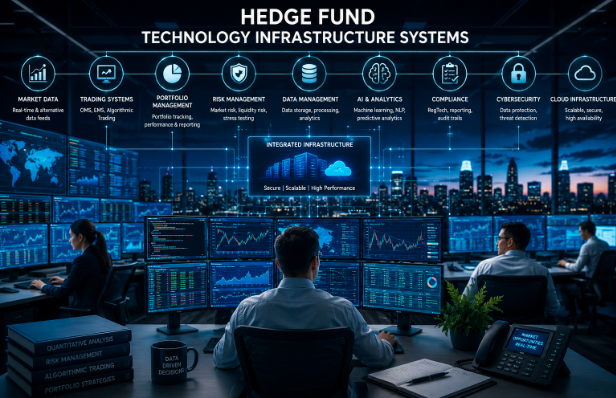
At the center of this transformation are hedge fund technology infrastructure systems. These systems form the technological backbone of hedge fund operations and help firms maintain efficiency, accuracy, security, and competitiveness.
As financial markets become increasingly complex and data-driven, technology is no longer just a support function. It has become a strategic advantage that directly influences investment performance and operational success.
This guide explores hedge fund technology infrastructure systems in detail, covering their components, benefits, challenges, and future developments.
What Are Hedge Fund Technology Infrastructure Systems?
Hedge fund technology infrastructure systems refer to the collection of software, hardware, networks, databases, cloud services, cybersecurity solutions, and analytical tools that support the day-to-day activities of a hedge fund.
These systems help firms:
- Execute trades efficiently
- Analyze market opportunities
- Manage investment portfolios
- Monitor risks
- Ensure regulatory compliance
- Protect sensitive data
- Generate investor reports
Without a strong technology infrastructure, hedge funds would struggle to process large volumes of information and compete effectively in modern financial markets.
Why Technology Infrastructure Matters
Technology infrastructure impacts nearly every aspect of hedge fund operations. It influences decision-making speed, trade execution quality, operational efficiency, and overall profitability.
Key benefits include:
| Benefit | Impact |
|---|---|
| Faster Trading | Improved execution speed |
| Better Analytics | Enhanced investment decisions |
| Risk Reduction | Real-time monitoring |
| Automation | Lower operational costs |
| Scalability | Supports business growth |
| Security | Protects critical financial data |
A well-designed infrastructure allows hedge funds to focus on generating returns while minimizing operational challenges.
Evolution of Hedge Fund Technology
Traditional Hedge Fund Operations
Years ago, hedge funds relied heavily on manual processes. Portfolio managers conducted research using limited information sources, and traders executed orders through phone calls or basic electronic systems.
Common limitations included:
- Slow information processing
- Delayed trade execution
- Higher operational risks
- Limited data availability
As financial markets became more competitive, these traditional approaches became insufficient.
Digital Transformation
The rise of high-speed internet, cloud computing, and advanced software transformed hedge fund operations.
Modern hedge funds now use:
- Real-time market data
- Automated trading systems
- Artificial intelligence
- Machine learning algorithms
- Cloud-based infrastructure
This digital transformation has significantly improved speed, accuracy, and efficiency.
Future Technology Trends
The future of hedge fund technology infrastructure systems is expected to be driven by:
- Artificial Intelligence
- Quantum Computing
- Blockchain Technology
- Advanced Predictive Analytics
- Autonomous Trading Systems
These innovations will continue reshaping investment management.
Core Components of Hedge Fund Technology Infrastructure
Trading Systems
Trading systems represent one of the most important elements of hedge fund operations.
Order Management Systems (OMS)
An Order Management System helps hedge funds manage the entire trade lifecycle.
Functions include:
- Creating orders
- Routing trades
- Monitoring execution
- Maintaining audit trails
OMS platforms improve operational efficiency and reduce human error.
Execution Management Systems (EMS)
An EMS focuses specifically on trade execution.
Benefits include:
- Faster execution
- Better pricing opportunities
- Access to multiple exchanges
- Reduced transaction costs
By combining OMS and EMS capabilities, hedge funds can manage trading activities more effectively.
Algorithmic Trading Platforms
Many hedge funds now rely on algorithms to execute trades automatically.
These platforms:
- Analyze market conditions
- Identify opportunities
- Execute orders without human intervention
Algorithmic trading enables firms to react quickly to market changes.
Market Data Infrastructure
Market data is the foundation of investment decision-making.
Real-Time Data Feeds
Hedge funds require continuous access to information from:
- Stock markets
- Bond markets
- Foreign exchange markets
- Commodities markets
- Cryptocurrency markets
Real-time data allows traders and portfolio managers to make informed decisions.
Alternative Data Sources
Modern hedge funds increasingly use alternative data.
Examples include:
- Social media activity
- Consumer spending patterns
- Website traffic statistics
- Satellite imagery
- Supply chain information
Alternative data provides unique insights that traditional financial statements may not reveal.
Portfolio Management Systems
Portfolio Management Systems (PMS) help hedge funds monitor and manage investments.
These systems provide:
- Position tracking
- Performance analysis
- Asset allocation monitoring
- Reporting capabilities
Portfolio managers can quickly evaluate investment performance and adjust strategies accordingly.
Key Functions of PMS
| Function | Purpose |
| Portfolio Tracking | Monitor investments |
| Performance Reporting | Measure returns |
| Asset Allocation | Manage diversification |
| Risk Analysis | Assess exposures |
| Client Reporting | Communicate results |
A powerful PMS improves transparency and decision-making.
Risk Management Systems
Risk management is a critical part of hedge fund operations.
Technology allows firms to identify and respond to risks more effectively.
Market Risk Monitoring
Market risk systems evaluate:
- Volatility levels
- Market exposure
- Correlations between assets
This information helps hedge funds avoid excessive risk concentrations.
Liquidity Risk Assessment
Liquidity management ensures that investments can be bought or sold when necessary.
Technology tools monitor:
- Trading volume
- Cash availability
- Market depth
These metrics help firms maintain financial flexibility.
Stress Testing
Stress testing systems simulate extreme market events.
Examples include:
- Financial crises
- Interest rate shocks
- Market crashes
By modeling different scenarios, hedge funds can prepare for adverse conditions.
Data Management Architecture
Data is often considered the most valuable asset within modern hedge funds.
Data Collection
Hedge funds collect information from numerous sources:
- Market exchanges
- Economic reports
- News services
- Alternative data providers
- Internal research teams
Managing this information requires sophisticated infrastructure.
Data Storage Solutions
Modern firms typically use:
Data Warehouses
Structured repositories designed for reporting and analytics.
Data Lakes
Flexible environments that store both structured and unstructured data.
Hybrid Systems
Many hedge funds combine multiple storage approaches to maximize efficiency.
Data Processing
Advanced processing technologies support:
- Real-time analytics
- Historical analysis
- Predictive modeling
- Machine learning applications
Efficient data processing improves investment decision quality.
Cloud Computing in Hedge Funds
Cloud computing has transformed financial technology infrastructure.
Benefits of Cloud Adoption
Cloud platforms provide:
- Scalability
- Cost savings
- Flexibility
- Global accessibility
Rather than purchasing expensive hardware, firms can access computing resources on demand.
Public vs Private Cloud
| Feature | Public Cloud | Private Cloud |
| Cost | Lower | Higher |
| Control | Moderate | High |
| Security | Strong | Very Strong |
| Customization | Limited | Extensive |
| Maintenance | Provider Managed | Internal Management |
Many hedge funds adopt hybrid solutions that combine both models.
Multi-Cloud Strategies
Using multiple cloud providers reduces dependency on a single vendor and enhances operational resilience.
Cybersecurity Infrastructure
Cybersecurity is one of the most important aspects of hedge fund technology infrastructure systems.
Financial firms manage highly sensitive information, making them attractive targets for cybercriminals.
Common Threats
Cybersecurity risks include:
- Phishing attacks
- Malware infections
- Data breaches
- Insider threats
- Ransomware attacks
Security Measures
Leading hedge funds implement:
- Multi-factor authentication
- Encryption
- Security monitoring
- Intrusion detection systems
- Network segmentation
Strong cybersecurity protects both the firm and its investors.
Artificial Intelligence and Machine Learning
Artificial intelligence has become a major competitive advantage.
AI-Powered Research
AI can analyze vast datasets significantly faster than human analysts.
Applications include:
- Market prediction
- Trend identification
- Investment screening
Machine Learning Models
Machine learning algorithms improve over time by analyzing historical data.
Benefits include:
- Enhanced forecasting
- Pattern recognition
- Improved trading signals
Natural Language Processing
NLP technology analyzes:
- News articles
- Earnings calls
- Regulatory filings
- Social media discussions
This enables hedge funds to identify investment opportunities faster.
Quantitative Trading Infrastructure
Quantitative investing relies heavily on technology.
What Is Quantitative Trading?
Quantitative trading uses mathematical models and statistical techniques to identify trading opportunities.
Instead of relying solely on human judgment, investment decisions are supported by data-driven analysis.
Infrastructure Requirements
Successful quantitative strategies require:
- High-performance computing
- Low-latency networks
- Massive data storage
- Advanced modeling software
Without adequate infrastructure, quantitative strategies cannot operate effectively.
Compliance and Regulatory Technology
Regulatory requirements continue to increase globally.
Technology helps hedge funds meet these obligations efficiently.
Compliance Automation
Automated systems perform tasks such as:
- Trade surveillance
- Reporting
- Record keeping
- Audit trail creation
Automation reduces manual workload and improves accuracy.
Benefits of RegTech
Regulatory technology offers several advantages:
- Reduced compliance costs
- Faster reporting
- Improved transparency
- Lower risk of violations
As regulations evolve, technology becomes increasingly important.
Disaster Recovery and Business Continuity
Unexpected disruptions can severely impact operations.
Technology infrastructure must support business continuity.
Backup Systems
Hedge funds typically maintain:
- Data backups
- Secondary servers
- Geographic redundancy
These measures ensure information remains accessible during emergencies.
Disaster Recovery Planning
Recovery plans define procedures for:
- System outages
- Cyberattacks
- Natural disasters
- Infrastructure failures
Regular testing helps ensure preparedness.
Infrastructure Challenges Facing Hedge Funds
Although technology offers many advantages, it also presents challenges.
Rising Costs
Advanced infrastructure requires significant investment.
Expenses include:
- Software licenses
- Hardware upgrades
- Cloud services
- Cybersecurity solutions
Data Complexity
Managing massive datasets can be difficult and resource-intensive.
Talent Shortages
Technology-driven hedge funds require skilled professionals in:
- Data science
- Cybersecurity
- Software engineering
- Quantitative analysis
Finding qualified talent remains challenging.
Regulatory Pressure
Regulatory requirements continue expanding, creating additional operational demands.
Benefits of Advanced Technology Infrastructure
Organizations that invest in modern hedge fund technology infrastructure systems often experience substantial advantages.
These benefits include:
Faster Trade Execution
Technology enables rapid response to market opportunities.
Improved Risk Control
Real-time monitoring enhances risk management.
Better Investment Decisions
Advanced analytics provide deeper insights.
Operational Efficiency
Automation reduces repetitive tasks.
Business Scalability
Infrastructure supports future growth without major disruptions.
Together, these benefits create a strong competitive advantage.
Future of Hedge Fund Technology Infrastructure Systems
The future of hedge fund technology infrastructure systems will likely be defined by increased automation and intelligence.
Emerging developments include:
- AI-driven investment platforms
- Autonomous trading systems
- Quantum computing applications
- Blockchain-based settlement networks
- Predictive risk management tools
As technology advances, hedge funds will continue adopting innovative solutions to improve performance and efficiency.
Best Practices for Building a Hedge Fund Technology Infrastructure
Organizations seeking long-term success should focus on several best practices.
Develop a Clear Technology Strategy
Technology investments should align with business goals.
Invest in Scalable Systems
Infrastructure should support future growth.
Prioritize Cybersecurity
Security must remain a top priority.
Leverage Cloud Technologies
Cloud platforms offer flexibility and efficiency.
Continuously Upgrade Infrastructure
Regular modernization ensures competitiveness.
Following these practices helps hedge funds remain resilient in rapidly changing markets.
Conclusion
Hedge fund technology infrastructure systems have become the foundation of modern investment management. From trading platforms and portfolio management tools to cybersecurity solutions and artificial intelligence applications, technology influences every aspect of hedge fund operations.
As markets become more complex and competitive, firms must invest in robust infrastructure that supports speed, accuracy, security, and scalability. Organizations that successfully leverage modern technology can improve decision-making, reduce operational risks, strengthen compliance, and enhance overall performance.
Looking ahead, innovations such as artificial intelligence, machine learning, blockchain, and quantum computing are expected to further transform hedge fund operations. Firms that embrace these developments will be better positioned to compete in the evolving financial landscape and deliver long-term value to investors.
Related Articles
Latest Tech Scookietech: A Complete Guide to Modern Technology Trends and Innovations
Nurture Tech Tips EmbedTree: The Complete Guide to Smarter Technology Learning
Opera Tech Ventures Lead Investor: Complete Guide to Its Investment Strategy and Startup Impact
Tech Trends Gfxprojectality: The Future of Digital Innovation and Creative Technology
Input Technology Solutions: Complete Guide to Services, Technology Expertise, and Digital Innovation