





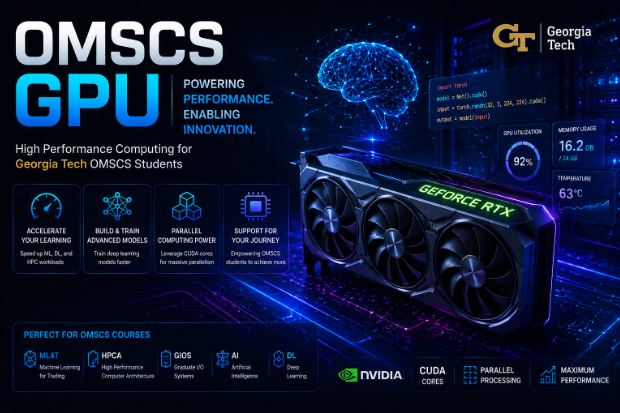
Introduction to OMSCS GPU
The OMSCS GPU course has become one of the most interesting technical courses available in the Georgia Tech Online Master of Science in Computer Science (OMSCS) program. Students interested in high-performance computing, parallel processing, artificial intelligence, and advanced software engineering often consider this course because it provides practical knowledge about modern graphics processing units (GPUs).
As technology continues to evolve, GPUs are no longer used only for gaming and graphics. They now power artificial intelligence systems, machine learning models, scientific simulations, data analytics platforms, and cloud computing environments. The OMSCS GPU course helps students understand how these powerful processors work and how to develop software that can fully utilize their capabilities.
This guide explains everything you need to know about OMSCS GPU, including course content, learning outcomes, projects, difficulty level, career opportunities, and whether it is worth taking.
What Is OMSCS?
OMSCS stands for Online Master of Science in Computer Science, a graduate-level degree program offered by Georgia Tech. The program allows students from around the world to earn a master’s degree in computer science without attending classes on campus.
The program covers multiple areas of computer science, including:
- Artificial Intelligence
- Machine Learning
- Computing Systems
- Cybersecurity
- Software Engineering
- Human-Computer Interaction
- High-Performance Computing
Among these advanced offerings, OMSCS GPU stands out because it focuses on one of the most important technologies driving modern computing.
Understanding GPU Technology
Before exploring the course itself, it is important to understand what a GPU is.
A Graphics Processing Unit (GPU) is a specialized processor designed to handle many operations simultaneously. Unlike traditional CPUs, which focus on sequential processing, GPUs are built for parallel computing.
This parallel design allows GPUs to process thousands of calculations at the same time, making them ideal for tasks involving large datasets and complex mathematical operations.
Today, GPUs are used in:
- Deep learning
- Artificial intelligence
- Scientific research
- Video rendering
- Cryptocurrency applications
- Data analytics
- Autonomous vehicles
The OMSCS GPU course teaches students how to take advantage of these capabilities.
What Is the OMSCS GPU Course?
OMSCS GPU, formally known as GPU Hardware and Software, is a specialized graduate-level course focused on understanding GPU architecture and programming techniques.
The course combines theoretical concepts with practical implementation. Students learn how GPU hardware works internally and how software developers can optimize applications to run efficiently on modern GPU systems.
Instead of simply using GPU libraries, students gain a deeper understanding of the mechanisms behind GPU performance.
Course Overview and Objectives
The primary goal of OMSCS GPU is to teach students how modern GPUs operate and how software can be designed to maximize their performance.
Students learn:
- GPU architecture fundamentals
- Parallel programming concepts
- CUDA development
- Compiler optimization techniques
- Memory hierarchy management
- Performance tuning methods
- GPU execution models
The course aims to bridge the gap between hardware understanding and software implementation.
Why GPU Computing Matters Today
GPU computing has become a cornerstone of modern technology.
Artificial intelligence systems such as large language models require enormous computational power. GPUs provide the processing capabilities needed to train and deploy these systems efficiently.
Scientific institutions also rely on GPUs for simulations involving weather forecasting, molecular biology, physics research, and medical imaging.
The increasing demand for computational performance means professionals with GPU expertise are becoming highly valuable across industries.
Key Topics Covered in OMSCS GPU
GPU Programming Fundamentals
Students begin by learning the foundations of parallel computing. They explore how tasks can be divided into smaller workloads and executed simultaneously.
This foundation helps students understand why GPU-based applications often outperform CPU-based implementations for certain workloads.
CUDA Programming
CUDA is one of the most important technologies taught in OMSCS GPU.
CUDA is a parallel computing platform developed by NVIDIA that enables developers to write programs that run directly on GPUs.
Students learn how to:
- Create CUDA kernels
- Manage threads and blocks
- Launch GPU computations
- Transfer data between CPU and GPU memory
GPU Architecture
Understanding hardware architecture is a major component of the course.
Students explore:
- Streaming Multiprocessors
- Warp scheduling
- Execution pipelines
- Register files
- Memory subsystems
- Cache hierarchies
This knowledge helps developers optimize software performance.
Memory Management
Memory operations significantly impact GPU performance.
The OMSCS GPU course explains:
| Memory Type | Purpose |
|---|---|
| Global Memory | Large storage accessible by all threads |
| Shared Memory | Fast memory shared within thread blocks |
| Registers | Fastest memory for individual threads |
| Constant Memory | Read-only memory for fixed values |
| Texture Memory | Specialized memory for graphics-related tasks |
Students learn when and how to use each memory type efficiently.
Performance Optimization
Optimization is one of the most valuable skills developed during the course.
Students learn techniques such as:
- Memory coalescing
- Thread optimization
- Warp efficiency improvement
- Reducing memory bottlenecks
- Occupancy tuning
These techniques can dramatically improve application performance.
Skills You Will Learn from OMSCS GPU
The OMSCS GPU course provides both theoretical and practical skills.
By the end of the course, students typically gain experience in:
- Parallel algorithm design
- CUDA development
- GPU debugging
- Performance profiling
- Hardware-aware programming
- Compiler optimization
- High-performance computing
These skills are highly transferable across many technology sectors.
Prerequisites for Taking the Course
OMSCS GPU is considered an advanced course.
Students benefit from having knowledge of:
- C or C++ programming
- Computer architecture
- Operating systems
- Algorithms
- Data structures
Although some concepts are introduced during the course, prior experience can make learning significantly easier.
Programming Languages and Tools Used
Students work with several technologies throughout the course.
Common tools include:
| Tool | Purpose |
| C++ | Core programming language |
| CUDA | GPU programming platform |
| Linux | Development environment |
| Profiling Tools | Performance analysis |
| Compiler Utilities | Code optimization |
These tools closely resemble those used in professional GPU development environments.
Course Projects and Assignments
One reason many students enjoy OMSCS GPU is its hands-on nature.
Projects allow students to apply concepts learned during lectures.
Assignments often involve:
- Implementing GPU algorithms
- Measuring performance gains
- Optimizing memory access
- Comparing CPU and GPU execution
- Analyzing bottlenecks
These practical experiences reinforce theoretical knowledge.
Understanding GPU Hardware Architecture
A strong understanding of hardware architecture separates average GPU programmers from highly effective ones.
The OMSCS GPU course explains how thousands of GPU cores coordinate execution.
Students study:
- Thread scheduling
- Execution units
- Memory pathways
- Instruction pipelines
- Resource allocation
Understanding these components helps developers write efficient code rather than relying solely on trial and error.
GPU vs CPU: Key Differences
The following comparison highlights why GPUs are so effective for parallel workloads.
| Feature | CPU | GPU |
| Core Count | Low | Very High |
| Sequential Tasks | Excellent | Moderate |
| Parallel Tasks | Limited | Excellent |
| AI Workloads | Good | Outstanding |
| Scientific Computing | Good | Excellent |
| Data Processing Scale | Moderate | High |
The OMSCS GPU course explores these differences in depth.
Real-World Applications of GPU Computing
GPU technology influences many industries.
Artificial intelligence systems use GPUs for neural network training. Scientific researchers rely on GPUs for simulations involving billions of calculations. Financial institutions use GPUs for risk analysis and quantitative modeling.
Other applications include:
- Medical imaging
- Robotics
- Cloud computing
- Computer vision
- Video processing
- Autonomous driving systems
Understanding these applications helps students appreciate the practical value of GPU expertise.
Benefits of Studying OMSCS GPU
There are numerous benefits associated with completing OMSCS GPU.
Students gain exposure to advanced technologies that are increasingly important in modern computing environments.
Additional advantages include:
- Improved system-level understanding
- Stronger optimization skills
- Better knowledge of parallel computing
- Practical development experience
- Enhanced career opportunities
These benefits often extend beyond GPU programming itself.
Challenges Students May Face
Like many advanced graduate courses, OMSCS GPU can be challenging.
Common difficulties include:
- Complex hardware concepts
- CUDA debugging
- Optimization strategies
- Parallel programming logic
- Project workload
Students who consistently practice and engage with course materials generally overcome these challenges successfully.
Tips for Success in OMSCS GPU
Success in OMSCS GPU often comes from preparation and persistence.
Helpful strategies include:
- Strengthen C++ fundamentals before enrollment.
- Review computer architecture concepts.
- Practice Linux development workflows.
- Learn basic CUDA syntax early.
- Start assignments as soon as they are released.
- Focus on understanding performance analysis.
These habits can significantly improve learning outcomes.
OMSCS GPU Workload and Difficulty Level
Many students consider OMSCS GPU moderately to highly challenging.
The workload varies depending on prior experience with systems programming and parallel computing.
Students with strong backgrounds in computer architecture and C++ often adapt more quickly, while others may need additional time to understand advanced concepts.
Despite the challenge, many students find the course highly rewarding because the skills gained are directly applicable to modern technology careers.
Career Opportunities After Learning GPU Programming
GPU expertise opens doors to numerous technical roles.
Potential career paths include:
- GPU Software Engineer
- Machine Learning Engineer
- AI Infrastructure Engineer
- High-Performance Computing Developer
- Systems Engineer
- Research Engineer
- Scientific Computing Specialist
These positions are increasingly in demand as organizations expand their use of accelerated computing technologies.
Future of GPU Computing and AI
The future of computing is closely connected to GPU technology.
Artificial intelligence continues to drive demand for more powerful hardware. Companies around the world are investing heavily in GPU infrastructure to support advanced AI systems and large-scale data processing.
As GPU capabilities evolve, professionals who understand both hardware and software optimization will remain highly valuable.
Is OMSCS GPU Worth It?
For students interested in systems programming, artificial intelligence infrastructure, high-performance computing, or hardware optimization, OMSCS GPU is often considered one of the most valuable technical courses available in the program.
The course combines theoretical depth with practical application, helping students develop skills that are increasingly important in modern computing environments. While the workload can be demanding, the knowledge gained can significantly improve both technical expertise and career opportunities.
Final Verdict
OMSCS GPU provides a comprehensive introduction to GPU hardware and software development while also exploring advanced optimization and performance concepts. Through CUDA programming, architecture analysis, memory management, and hands-on projects, students gain valuable experience that extends far beyond traditional software development.
As GPUs continue powering innovations in artificial intelligence, machine learning, scientific research, and cloud computing, the relevance of OMSCS GPU will only continue to grow. For students seeking a deeper understanding of high-performance computing and modern processor architectures, this course represents an excellent learning opportunity.
Frequently Asked Questions
Is OMSCS GPU suitable for beginners?
The course is advanced and is best suited for students with experience in programming and computer systems.
Does OMSCS GPU require CUDA knowledge beforehand?
No, but basic familiarity with C++ programming can make learning CUDA easier.
Is OMSCS GPU useful for machine learning careers?
Yes. Understanding GPU computing is highly valuable for AI and machine learning infrastructure roles.
How difficult is OMSCS GPU compared to other OMSCS courses?
Most students consider it moderately to highly challenging due to its technical depth and optimization-focused assignments.
Is OMSCS GPU worth taking in 2026 and beyond?
Yes. As AI and high-performance computing continue growing, GPU expertise remains one of the most valuable technical skills in the industry.
Related Articles
Global Technology Audit Guide: Complete Guide to IT Auditing and Governance
Nurture Tech Tips EmbedTree: The Complete Guide to Smarter Technology Learning
Opera Tech Ventures Lead Investor: Complete Guide to Its Investment Strategy and Startup Impact
Hedge Fund Technology Infrastructure Systems: Complete Guide to Modern Investment Technology