





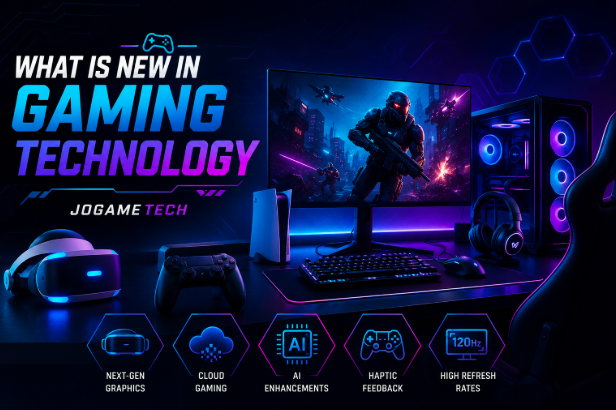
The gaming industry has experienced remarkable growth over the past few decades. What started as simple arcade games with basic graphics has transformed into a highly advanced digital ecosystem powered by artificial intelligence, cloud computing, virtual reality, and cutting-edge hardware. Many gamers and technology enthusiasts often ask, “what is new in gaming technology JogaMetech?” The answer lies in the rapid innovations that are changing how games are developed, played, and experienced across the world.
Gaming technology is no longer limited to better graphics or faster processors. Today’s advancements focus on creating immersive experiences, realistic environments, intelligent characters, and seamless online connectivity. As technology continues to evolve, gaming becomes more interactive, accessible, and engaging for players of all ages.
The Evolution of Gaming Technology
Gaming technology has come a long way from the early days of pixelated screens and limited gameplay mechanics. In the 1980s and 1990s, gaming systems focused primarily on improving graphics and processing power. As internet connectivity became widespread, multiplayer gaming emerged and transformed the gaming landscape.
Modern gaming now combines several advanced technologies into a single experience. Developers use powerful game engines, cloud infrastructure, machine learning, and high-performance hardware to create realistic virtual worlds. The evolution of gaming technology demonstrates how innovation continuously pushes the boundaries of entertainment.
Major Milestones in Gaming Technology
| Era | Key Innovation | Impact on Gaming |
|---|---|---|
| 1980s | Arcade Gaming | Popularized video games |
| 1990s | 3D Graphics | Improved visual realism |
| 2000s | Online Multiplayer | Connected players globally |
| 2010s | VR and Cloud Gaming | Enhanced immersion |
| 2020s | AI and Ray Tracing | Realistic and intelligent gameplay |
Artificial Intelligence (AI) in Gaming
Artificial intelligence is one of the most significant developments when discussing what is new in gaming technology JogaMetech. AI has transformed both game development and gameplay experiences.
In modern games, AI controls non-player characters (NPCs) that can react intelligently to player actions. Instead of following predictable patterns, AI-driven characters can adapt, learn, and make decisions based on changing situations. This creates more realistic and challenging gameplay.
Game developers also use AI during development. AI tools can help generate landscapes, design levels, create animations, and even write dialogue. As a result, development becomes faster and more efficient while maintaining high-quality standards.
Some key benefits of AI in gaming include:
- Smarter enemy behavior.
- Personalized gaming experiences.
- Faster game development.
- Dynamic game environments.
- Improved storytelling.
Cloud Gaming Revolution
Cloud gaming is changing how people access and play games. Traditionally, gamers needed expensive consoles or high-end PCs to run demanding titles. Cloud gaming eliminates many of these hardware limitations by processing games on remote servers.
When players use cloud gaming services, the game runs in a data center while video streams directly to their device. This means users can enjoy high-quality games on smartphones, tablets, laptops, and even smart TVs.
Cloud gaming offers several advantages:
- Reduced hardware costs.
- Instant access to games.
- Cross-device compatibility.
- Automatic updates and maintenance.
- Greater accessibility for casual gamers.
As internet infrastructure improves globally, cloud gaming is expected to become even more popular in the coming years.
Virtual Reality (VR) and Augmented Reality (AR)
Virtual Reality and Augmented Reality are among the most exciting innovations in modern gaming. These technologies provide immersive experiences that go beyond traditional screen-based gameplay.
Virtual Reality Gaming
Virtual Reality places players inside a fully digital environment. Using VR headsets, gamers can explore virtual worlds, interact with objects, and experience games from a first-person perspective.
VR gaming creates a stronger sense of presence because players physically move and interact within the game environment. This technology is particularly popular in simulation games, adventure titles, and training applications.
Augmented Reality Gaming
Augmented Reality overlays digital content onto the real world. Unlike VR, AR does not replace reality but enhances it with interactive virtual elements.
Popular mobile games have demonstrated how AR can blend digital experiences with real-world environments. As smartphone technology advances, AR gaming continues to expand into new areas.
Ray Tracing and Advanced Graphics
Graphics technology has reached unprecedented levels of realism. One of the most notable advancements is ray tracing.
Ray tracing is a rendering technique that simulates how light behaves in the real world. It produces highly realistic shadows, reflections, and lighting effects. The result is a visual experience that closely resembles reality.
Gamers can immediately notice the difference when playing titles that support ray tracing. Water reflections appear more natural, shadows become more detailed, and lighting dynamically changes based on environmental conditions.
Benefits of ray tracing include:
- Realistic lighting effects.
- Improved reflections.
- Better shadow quality.
- Enhanced immersion.
- More cinematic visuals.
Neural Graphics and AI Upscaling
Another important answer to the question “what is new in gaming technology JogaMetech” involves neural graphics and AI-powered upscaling.
Traditionally, improving graphics quality required more powerful hardware. AI upscaling technologies now allow games to look better without significantly increasing hardware demands.
These systems use artificial intelligence to reconstruct high-resolution images from lower-resolution frames. As a result, players enjoy smoother performance and sharper visuals simultaneously.
Neural graphics technology is becoming increasingly important as developers seek ways to deliver stunning graphics while maintaining stable frame rates.
Next-Generation Gaming Hardware
Gaming hardware continues to evolve at an impressive pace. Modern gaming devices feature powerful processors, advanced graphics cards, ultra-fast storage solutions, and high-refresh-rate displays.
The latest gaming hardware offers:
| Technology | Benefit |
| SSD Storage | Faster loading times |
| Advanced GPUs | Better graphics performance |
| High Refresh Displays | Smoother gameplay |
| Powerful CPUs | Improved processing speed |
| Enhanced Cooling Systems | Stable performance |
These improvements contribute to a more responsive and enjoyable gaming experience.
Handheld gaming devices have also gained popularity. Modern portable systems now deliver performance levels previously limited to desktop gaming PCs.
Haptic Feedback and Immersive Controls
Gaming immersion is no longer limited to visuals and audio. Haptic technology allows players to physically feel actions occurring within a game.
Modern controllers use advanced vibration systems to simulate various sensations such as:
- Driving on rough roads.
- Recoil from weapons.
- Environmental effects.
- Character movement.
These tactile responses create a deeper connection between players and the virtual world.
Developers continue to explore new methods of delivering realistic sensory feedback, making gaming experiences increasingly immersive.
The Role of 5G in Gaming
The introduction of 5G networks has significantly improved online gaming experiences. Faster internet speeds and lower latency allow players to enjoy smoother multiplayer gameplay with fewer interruptions.
5G technology benefits gaming in several ways:
- Reduced lag during online matches.
- Faster downloads and updates.
- Improved cloud gaming performance.
- Better mobile gaming experiences.
- Enhanced multiplayer connectivity.
As network technology continues to advance, gamers can expect even more reliable and responsive online experiences.
Cross-Platform Gaming and Esports
Cross-platform gaming has become increasingly important in modern gaming ecosystems. Players using different devices can now compete and cooperate within the same game.
This approach creates larger gaming communities and allows friends to play together regardless of their preferred platform.
At the same time, esports continues to grow rapidly. Professional gaming tournaments attract millions of viewers worldwide. Advanced streaming technologies, performance analytics, and high-speed networks support the expanding esports industry.
The combination of cross-platform gaming and esports has transformed gaming into a global social activity and competitive profession.
Mobile Gaming Innovations
Mobile gaming has evolved far beyond simple puzzle and arcade games. Modern smartphones now feature powerful processors capable of running graphically demanding titles.
Several factors are driving mobile gaming innovation:
- Better mobile chipsets.
- Cloud gaming integration.
- Improved battery efficiency.
- Enhanced touch controls.
- Competitive mobile esports.
The accessibility of smartphones has made mobile gaming one of the fastest-growing segments of the gaming industry.
The Future of Gaming Technology
The future of gaming promises even greater innovation. Researchers and developers are already exploring technologies that could redefine interactive entertainment.
Emerging trends include:
- Advanced AI-generated worlds.
- Fully immersive virtual environments.
- Brain-computer interfaces.
- Hyper-realistic graphics.
- Expanded metaverse experiences.
These technologies may eventually blur the line between physical and digital realities, creating entirely new forms of entertainment.
Benefits and Challenges of Modern Gaming Technology
While technological innovation provides numerous advantages, it also presents certain challenges.
Benefits
Modern gaming technology improves accessibility, enhances realism, enables social interaction, and creates new opportunities for education and professional training.
Challenges
The industry must also address concerns such as development costs, hardware affordability, cybersecurity risks, data privacy issues, and ethical questions surrounding artificial intelligence.
Balancing innovation with responsibility will remain a key priority as gaming technology continues to evolve.
Conclusion
Understanding what is new in gaming technology JogaMetech reveals an industry undergoing constant transformation. Artificial intelligence, cloud gaming, virtual reality, ray tracing, neural graphics, 5G connectivity, advanced hardware, and immersive controls are reshaping how games are created and experienced.
These innovations are making gaming more realistic, accessible, and engaging than ever before. As technology continues to advance, players can expect even more groundbreaking developments that push the boundaries of digital entertainment. The future of gaming is filled with exciting possibilities, and the innovations emerging today will define the next generation of interactive experiences.
Related Articles
Tech FeedBuzzard: Your Complete Guide to Modern Technology News, Trends, and Insights
Techidemics Tech: Complete Guide to the Technology Platform
Teijin Automotive Technologies: Advanced Composite Solutions Transforming the Automotive Industry