





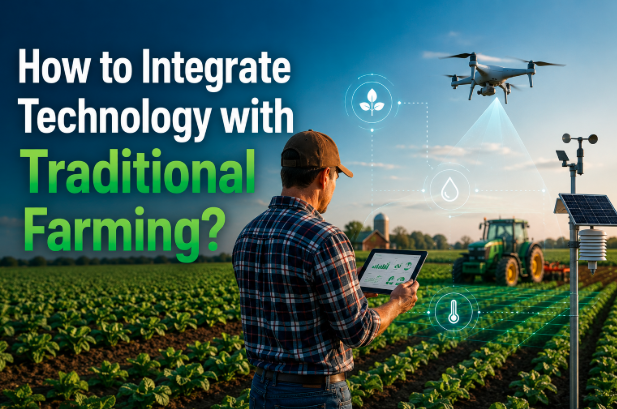
Introduction to Technology and Traditional Farming
Agriculture has been the foundation of human civilization for thousands of years. Traditional farming methods have helped communities produce food, support local economies, and preserve agricultural knowledge passed down through generations. However, modern farmers face new challenges, including climate change, labor shortages, rising production costs, and increasing food demand. These challenges have made it essential to explore innovative solutions that improve farming efficiency without abandoning valuable traditional practices.
Understanding how to integrate technology with traditional farming has become increasingly important in today’s agricultural landscape. Technology does not replace traditional farming; instead, it enhances existing methods by providing better information, improving productivity, and helping farmers make informed decisions. By combining experience-based farming knowledge with modern innovations, farmers can achieve better results while maintaining sustainable agricultural practices.
Understanding the Need for Technology in Agriculture
The agricultural industry is under constant pressure to produce more food using limited resources. Population growth continues to increase global food demand, while available farmland remains limited. At the same time, unpredictable weather patterns and environmental concerns make farming more challenging than ever before.
Traditional farming methods offer valuable experience and local knowledge, but they may not always provide enough information to address modern agricultural problems. Technology helps fill these gaps by offering data-driven insights that improve decision-making. Weather monitoring tools, soil analysis systems, and farm management software allow farmers to respond more effectively to changing conditions.
Several factors have increased the need for agricultural technology:
| Challenge | Impact on Farmers | Technology Solution |
|---|---|---|
| Climate Change | Unpredictable weather | Weather forecasting tools |
| Labor Shortages | Higher labor costs | Automated machinery |
| Water Scarcity | Reduced crop growth | Smart irrigation systems |
| Pest Outbreaks | Crop damage | Drones and monitoring tools |
| Rising Costs | Lower profitability | Precision farming technology |
As agriculture continues to evolve, farmers who successfully combine traditional knowledge with technological innovations are often better prepared for future challenges.
The Benefits of Integrating Technology with Traditional Farming
Learning how to integrate technology with traditional farming offers numerous advantages. One of the most significant benefits is improved productivity. Modern technologies help farmers monitor crops more accurately, allowing them to identify issues before they become major problems.
Technology also improves resource management. Water, fertilizers, pesticides, and fuel can be used more efficiently when farmers have access to accurate data about field conditions. This not only reduces operating costs but also minimizes environmental impact.
Another important advantage is sustainability. Traditional farming often emphasizes long-term land stewardship, while technology provides tools that support sustainable resource management. Together, they create a balanced approach that benefits both farmers and the environment.
Additional benefits include:
- Increased crop yields
- Better soil management
- Reduced waste
- Improved farm profitability
- Enhanced decision-making
- Greater environmental sustainability
The combination of traditional expertise and modern innovation creates a farming system that is both productive and resilient.
Smart Irrigation Systems and Water Management
Water is one of the most valuable resources in agriculture. Traditional farmers have long relied on experience and observation to determine irrigation schedules. While this knowledge remains valuable, modern irrigation technologies can significantly improve water efficiency.
Smart irrigation systems use sensors to measure soil moisture levels and automatically adjust watering schedules based on actual crop needs. Instead of following fixed irrigation routines, farmers can provide water precisely when and where it is needed.
For example, a farmer who traditionally irrigates crops every three days may discover through soil moisture sensors that some areas require less frequent watering. This information helps conserve water while maintaining healthy crop growth.
The integration of traditional water management practices with modern monitoring systems allows farmers to maximize crop productivity while reducing water waste. In regions where water scarcity is a growing concern, smart irrigation can play a critical role in sustainable agriculture.
Precision Farming and GPS Technology
Precision farming is one of the most effective examples of how to integrate technology with traditional farming. This approach uses GPS technology, sensors, and mapping systems to collect detailed information about agricultural fields.
Traditional farmers often understand variations within their fields through years of experience. Precision agriculture enhances this knowledge by providing accurate data about soil conditions, nutrient levels, and crop performance across different areas.
GPS-guided equipment allows farmers to plant seeds, apply fertilizers, and spray pesticides with remarkable accuracy. This reduces waste and ensures that resources are applied only where needed.
Some key benefits of precision farming include:
- More accurate field management
- Reduced fertilizer usage
- Lower pesticide application costs
- Improved crop yields
- Better environmental protection
By combining traditional field knowledge with precise technological measurements, farmers can optimize agricultural operations and increase profitability.
Using Drones for Crop Monitoring
Drones have become valuable tools in modern agriculture. These unmanned aerial vehicles provide farmers with detailed aerial views of their fields, allowing them to monitor crop health more efficiently than traditional field inspections alone.
Traditionally, farmers walk through fields to identify signs of disease, pest infestations, or irrigation problems. While this practice remains important, drones can cover large areas quickly and identify issues that may not be visible from ground level.
High-resolution cameras and specialized sensors capture detailed images that help farmers detect stress in crops before visible symptoms appear. Early detection allows for faster intervention and can prevent significant yield losses.
Drones are particularly useful for:
- Crop health monitoring
- Pest detection
- Disease identification
- Irrigation assessment
- Field mapping
When combined with traditional field observations, drone technology provides a more complete understanding of crop conditions.
Mobile Apps and Digital Farm Management Tools
Smartphones have become essential tools for modern farmers. Mobile applications provide access to valuable information that supports daily farming activities and long-term planning.
Farm management apps help farmers maintain records, track expenses, schedule tasks, and monitor crop performance. Weather applications provide real-time forecasts that help farmers plan planting, irrigation, and harvesting activities more effectively.
Market information apps also allow farmers to monitor commodity prices and identify favorable selling opportunities. This helps improve financial planning and increases profitability.
Digital tools support traditional farming practices by making information more accessible and easier to manage. Rather than replacing farmer expertise, these applications enhance decision-making through better organization and data access.
Modern Machinery in Traditional Farming Practices
Agricultural machinery has transformed farming operations around the world. Tractors, harvesters, seed drills, and other equipment help farmers complete tasks more efficiently while reducing physical labor requirements.
Traditional farming methods often involve manual labor that can be time-consuming and physically demanding. Modern machinery helps farmers accomplish these tasks more quickly while maintaining the quality of agricultural operations.
The goal is not to eliminate traditional farming practices but to improve efficiency where appropriate. For example, a farmer may continue using traditional crop rotation techniques while utilizing modern machinery for planting and harvesting.
Benefits of modern agricultural equipment include:
| Equipment Type | Traditional Task | Technology Advantage |
| Tractor | Manual field preparation | Faster soil cultivation |
| Seed Drill | Hand sowing | Uniform seed placement |
| Harvester | Manual harvesting | Reduced labor needs |
| Sprayer | Manual spraying | Accurate chemical application |
| Cultivator | Hand weeding | Improved weed control |
This balanced approach allows farmers to preserve valuable agricultural traditions while benefiting from technological advancements.
The Role of Artificial Intelligence and Data Analytics
Artificial Intelligence (AI) is becoming increasingly important in agriculture. AI systems analyze large amounts of agricultural data and provide recommendations that help farmers improve productivity.
Data collected from sensors, weather stations, drones, and farm equipment can be processed using AI algorithms to identify patterns and predict future outcomes. These predictions help farmers make more informed decisions about planting schedules, irrigation strategies, and pest management.
For example, AI systems can predict potential disease outbreaks based on weather conditions and historical crop data. This allows farmers to take preventive measures before problems become severe.
Data analytics also supports better resource allocation, helping farmers reduce costs while maintaining high levels of productivity. When combined with traditional farming experience, AI becomes a powerful decision-support tool.
Challenges of Integrating Technology with Traditional Farming
Although technology offers many benefits, adopting new systems is not always easy. One of the primary challenges is the initial cost of purchasing equipment, software, and monitoring tools. Small-scale farmers may find these investments difficult to afford.
Technical knowledge is another obstacle. Some farmers may require training to effectively use modern agricultural technologies. Without proper education and support, technology adoption can be slow.
Infrastructure limitations also present challenges in certain regions. Reliable internet access and electricity are often necessary for advanced agricultural systems. In rural areas, these resources may not always be available.
Common challenges include:
- High startup costs
- Lack of technical training
- Limited internet connectivity
- Equipment maintenance requirements
- Resistance to change
Despite these challenges, many farmers find that the long-term benefits of technology outweigh the initial difficulties.
Future Trends in Smart Agriculture
The future of agriculture will likely involve even greater integration between technology and traditional farming practices. Innovations such as the Internet of Things (IoT), robotics, and advanced automation are expected to become more common.
IoT devices will allow farmers to monitor fields, equipment, and livestock in real time. Automated systems may handle routine tasks such as irrigation, fertilization, and crop monitoring with minimal human intervention.
Robotic technologies could help address labor shortages by performing tasks such as planting, harvesting, and weed control. At the same time, sustainable farming technologies will continue to focus on reducing environmental impact and conserving natural resources.
As these innovations develop, the importance of understanding how to integrate technology with traditional farming will continue to grow. Farmers who successfully combine modern tools with established agricultural knowledge will be well-positioned for future success.
Conclusion
The future of agriculture depends on finding the right balance between innovation and tradition. Traditional farming practices provide valuable knowledge developed through generations of experience, while modern technologies offer powerful tools that improve efficiency, productivity, and sustainability.
Learning how to integrate technology with traditional farming allows farmers to benefit from both approaches. Smart irrigation systems, precision agriculture, drones, mobile applications, modern machinery, and artificial intelligence all contribute to better farm management and improved agricultural outcomes.
Rather than replacing traditional methods, technology strengthens them by providing additional information and greater operational efficiency. Farmers who embrace this balanced approach can improve crop yields, reduce costs, conserve resources, and build more resilient farming systems for future generations.
Related Articles
How Future Healthcare Technology Is Elevating At-Home Care: 10 Innovations Changing Healthcare
How Smart Home Technology Will Change Lives?
Can Laptop Go Into Checked Luggage? Complete Airline Rules & Safety Guide
Laptop for Tuning Cars: Complete Guide for Beginners and Professionals