




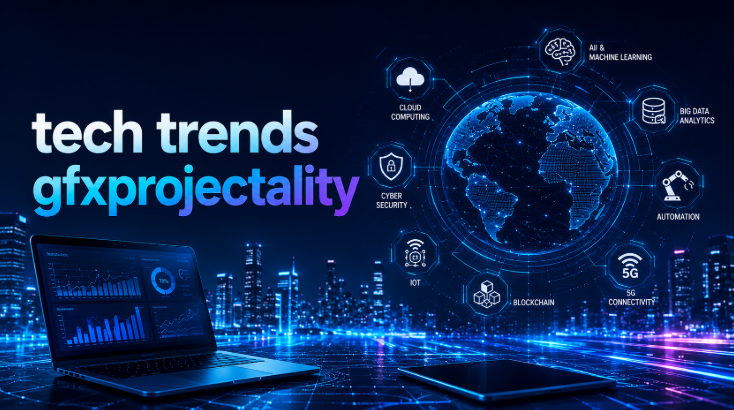
Introduction to Tech Trends Gfxprojectality
Technology continues to evolve at a remarkable pace, changing how people work, communicate, create, and experience digital content. One concept gaining attention among technology enthusiasts, designers, businesses, and digital creators is tech trends gfxprojectality. This term represents the combination of advanced technologies, creative innovation, and modern digital experiences that are shaping the future.
As organizations seek better ways to engage audiences and improve productivity, they are increasingly adopting technologies such as artificial intelligence, virtual reality, cloud computing, and automation. Tech trends gfxprojectality brings these innovations together to create smarter, more interactive, and highly personalized experiences.
Understanding these trends is important because they influence nearly every industry, from marketing and education to healthcare and entertainment. This guide explores the major technologies, benefits, challenges, and future opportunities associated with tech trends gfxprojectality.
Understanding the Concept of Gfxprojectality
The term Gfxprojectality is often associated with the intersection of technology and digital creativity. It focuses on leveraging innovative tools and techniques to create engaging experiences for users while improving efficiency and performance.
Rather than viewing technology and creativity as separate fields, Gfxprojectality combines them into a unified approach. This allows businesses and creators to develop more immersive, visually appealing, and functional digital solutions.
The concept revolves around several key elements:
- Innovation-driven design
- Advanced digital technologies
- Interactive user experiences
- Automation and efficiency
- Data-driven decision-making
As technology becomes more sophisticated, the role of Gfxprojectality continues to expand across multiple industries.
Why Tech Trends Gfxprojectality Matters in 2026
The digital world is becoming increasingly competitive. Businesses need innovative ways to attract customers and maintain engagement. This is where tech trends gfxprojectality becomes valuable.
Consumers today expect personalized experiences, fast performance, and interactive content. Traditional methods are often insufficient to meet these expectations. Modern technologies provide the tools necessary to deliver richer and more meaningful digital interactions.
Several factors contribute to the growing importance of these trends:
| Factor | Impact |
|---|---|
| Digital Transformation | Accelerates business innovation |
| Customer Expectations | Demands personalized experiences |
| AI Adoption | Improves efficiency and automation |
| Remote Work Growth | Encourages cloud collaboration |
| Immersive Technologies | Enhances user engagement |
Organizations that embrace these trends often gain a competitive advantage in their respective markets.
Artificial Intelligence (AI) in Gfxprojectality
AI-Powered Design Tools
Artificial intelligence has transformed how digital content is created. Modern AI tools can generate graphics, optimize designs, suggest layouts, and automate repetitive tasks.
Designers can now spend less time on routine work and more time focusing on creativity and strategy. AI-powered platforms can analyze user behavior and recommend improvements that enhance engagement.
Automated Content Creation
Content creation is another area benefiting from AI technology. Businesses can generate written content, visual assets, videos, and marketing materials faster than ever before.
Automation helps organizations maintain consistent output while reducing production costs.
Smart Image and Video Generation
AI systems can create realistic images, enhance video quality, and generate visual content based on user preferences. These capabilities are becoming increasingly valuable in marketing, gaming, and entertainment.
Benefits of AI
Some major benefits include:
- Increased productivity
- Reduced operational costs
- Better personalization
- Faster content production
- Improved decision-making
Augmented Reality (AR) and Virtual Reality (VR)
What Are AR and VR?
Augmented Reality overlays digital elements onto the real world, while Virtual Reality creates entirely immersive digital environments.
Both technologies are becoming essential components of tech trends gfxprojectality.
Enhancing User Experiences
AR and VR provide experiences that traditional digital platforms cannot match. Users can interact with products, environments, and information in entirely new ways.
For example, customers can virtually try products before purchasing, while students can participate in immersive educational simulations.
Applications Across Industries
Industries using AR and VR include:
- Gaming
- Healthcare
- Education
- Real Estate
- Manufacturing
- Retail
These technologies improve engagement while offering practical business benefits.
Real-Time Rendering Technology
Real-time rendering allows digital visuals to be generated instantly. Unlike traditional rendering methods that require extensive processing time, real-time rendering delivers immediate results.
This technology is especially valuable in:
- Video games
- Virtual reality environments
- Architectural visualization
- Product demonstrations
- Interactive simulations
The ability to view changes instantly improves collaboration and speeds up project completion.
Traditional vs Real-Time Rendering
| Feature | Traditional Rendering | Real-Time Rendering |
|---|---|---|
| Speed | Slow | Instant |
| Interactivity | Limited | High |
| User Feedback | Delayed | Immediate |
| Collaboration | Difficult | Easier |
Real-time rendering continues to become more powerful as hardware and software technologies improve.
Extended Reality (XR) and Mixed Reality
Extended Reality combines AR, VR, and Mixed Reality into a broader technology ecosystem.
Mixed Reality allows physical and digital objects to interact seamlessly. This creates opportunities for highly engaging experiences across various sectors.
Businesses use XR technologies for:
- Employee training
- Product visualization
- Remote collaboration
- Interactive marketing
- Virtual meetings
As hardware becomes more affordable, XR adoption is expected to increase significantly.
Cloud-Based Creative Workflows
Cloud computing has changed how teams collaborate and manage projects.
Instead of storing files locally, organizations can access resources through cloud platforms from virtually anywhere. This flexibility supports remote work and global collaboration.
Advantages of Cloud Workflows
Cloud-based systems provide numerous benefits:
- Easy file sharing
- Improved security
- Real-time collaboration
- Automatic backups
- Reduced infrastructure costs
Creative teams can work together efficiently regardless of geographic location.
5G and High-Speed Connectivity
The rollout of 5G networks represents another important development within tech trends gfxprojectality.
Faster internet speeds allow applications to process large amounts of data with minimal delays. This is especially important for technologies such as AR, VR, cloud gaming, and real-time collaboration tools.
Benefits of 5G Technology
- Lower latency
- Faster downloads
- Better streaming quality
- Improved device connectivity
- Enhanced cloud performance
These advantages enable richer digital experiences and support emerging technologies.
Automation and Smart Workflows
Automation is becoming a critical part of modern business operations.
Organizations use smart workflows to reduce repetitive tasks and improve efficiency. Automated systems can manage data processing, customer support, content scheduling, and numerous other functions.
Benefits of Automation
| Benefit | Description |
|---|---|
| Efficiency | Completes tasks faster |
| Accuracy | Reduces human errors |
| Cost Savings | Lowers operational expenses |
| Scalability | Supports business growth |
| Productivity | Frees employees for strategic work |
Automation allows teams to focus on innovation rather than routine activities.
The Role of Machine Learning
Machine learning is a subset of artificial intelligence that enables systems to learn from data and improve over time.
In the context of tech trends gfxprojectality, machine learning supports:
- Personalized recommendations
- Predictive analytics
- Customer behavior analysis
- Intelligent automation
- Enhanced user experiences
Businesses can use machine learning insights to make better decisions and deliver more relevant content to their audiences.
Interactive and Immersive User Experiences
User experience has become one of the most important factors in digital success.
Modern consumers expect engaging, interactive, and personalized experiences. Technologies such as AI, AR, VR, and XR help organizations meet these expectations.
Interactive experiences increase:
- Customer engagement
- Brand loyalty
- User satisfaction
- Conversion rates
- Retention levels
As digital competition grows, immersive experiences will become even more valuable.
Applications of Tech Trends Gfxprojectality Across Industries
Graphic Design Industry
Designers use advanced software, AI tools, and automation to create more sophisticated visual content.
Marketing and Advertising
Marketers leverage data analytics, AI, and immersive technologies to deliver targeted campaigns.
Gaming Industry
Gaming companies use real-time rendering, VR, and AI to create realistic and engaging experiences.
Education and E-Learning
Educational institutions use AR and VR to improve learning outcomes through interactive experiences.
Healthcare and Medical Training
Healthcare professionals use simulation technologies for training, diagnosis, and patient education.
Retail and E-Commerce
Retailers enhance shopping experiences through virtual product demonstrations and personalized recommendations.
Key Benefits of Adopting Gfxprojectality Trends
Organizations that embrace tech trends gfxprojectality can experience significant advantages.
These benefits include:
- Enhanced creativity and innovation.
- Improved customer engagement.
- Faster project completion.
- Better operational efficiency.
- Reduced costs.
- Increased competitiveness.
- Greater scalability.
- Stronger decision-making capabilities.
Collectively, these benefits help businesses adapt to changing market demands.
Challenges and Limitations
Despite its advantages, tech trends gfxprojectality also presents certain challenges.
Technical Complexity
Many advanced technologies require specialized knowledge and expertise.
High Initial Costs
Implementing new technologies may involve substantial investments.
Privacy and Security Concerns
As organizations collect more data, maintaining privacy and security becomes increasingly important.
Training Requirements
Employees often need additional training to effectively use new systems and tools.
Businesses must carefully plan their digital transformation strategies to overcome these challenges.
Future of Tech Trends Gfxprojectality
The future looks promising for tech trends gfxprojectality. Emerging technologies continue to push the boundaries of innovation.
Several developments are expected to shape the coming years:
- More advanced AI systems
- Wider XR adoption
- Growth of spatial computing
- Improved automation platforms
- Smarter digital assistants
- Enhanced personalization technologies
As these innovations mature, they will create new opportunities for businesses and consumers alike.
Best Practices for Businesses and Creators
To successfully adopt modern technology trends, organizations should focus on strategic implementation.
Some effective practices include:
Stay Updated
Technology evolves rapidly, making continuous learning essential.
Invest in Skills Development
Training employees ensures maximum value from new technologies.
Choose the Right Tools
Organizations should select solutions that align with their goals and requirements.
Prioritize User Experience
Technology should enhance the user experience rather than complicate it.
Maintain Strong Security Measures
Protecting user data should remain a top priority.
Common Mistakes to Avoid
Many organizations struggle with technology adoption because they make avoidable mistakes.
Common issues include:
- Overreliance on automation
- Ignoring customer feedback
- Failing to train employees
- Choosing technology without a clear strategy
- Neglecting cybersecurity measures
Avoiding these mistakes improves the likelihood of successful implementation.
Expert Tips for Success with Gfxprojectality
Organizations looking to maximize the value of tech trends gfxprojectality should focus on long-term innovation.
Key recommendations include:
- Experiment with emerging technologies.
- Use data to guide decisions.
- Balance automation with human creativity.
- Continuously improve user experiences.
- Monitor industry developments regularly.
Companies that embrace innovation while maintaining a customer-focused approach often achieve the best results.
Conclusion
Tech trends gfxprojectality represents the convergence of creativity, technology, and innovation. From artificial intelligence and machine learning to augmented reality, virtual reality, cloud computing, and automation, these technologies are transforming industries worldwide.
Businesses that understand and adopt these trends can improve efficiency, enhance customer engagement, and create more meaningful digital experiences. While challenges such as cost, complexity, and security concerns exist, the long-term benefits often outweigh the risks.
As technology continues to evolve, tech trends gfxprojectality will play an increasingly important role in shaping the future of digital innovation. Organizations, creators, and professionals who stay informed and adapt to these developments will be better positioned for success in the years ahead.
Frequently Asked Questions (FAQs)
What is Tech Trends Gfxprojectality?
Tech Trends Gfxprojectality refers to the integration of modern technologies such as AI, AR, VR, automation, and cloud computing to create innovative and immersive digital experiences.
How does artificial intelligence support Gfxprojectality?
AI helps automate tasks, generate content, analyze data, personalize experiences, and improve overall efficiency in digital workflows.
Why are AR and VR important in modern technology trends?
AR and VR provide immersive experiences that improve user engagement, learning, training, and product visualization.
Which industries benefit most from Tech Trends Gfxprojectality?
Industries including healthcare, education, gaming, retail, marketing, and graphic design benefit significantly from these emerging technologies.
What is the future of Tech Trends Gfxprojectality?
The future includes greater AI adoption, advanced XR technologies, spatial computing, improved automation, and increasingly personalized digital experiences.
Related Articles
Droven.io Technology Blog: Exploring AI, Innovation, and Modern Technology Trends
OMSCS GPU: Complete Guide to Georgia Tech’s GPU Hardware and Software Course
Camera Processing Services: A Complete Guide to Modern Image and Video Processing
Teris Camera RZ4C: Features, Specifications, Applications, and Complete Guide
Technologies HearthssGaming: Exploring the Future of Gaming Innovation